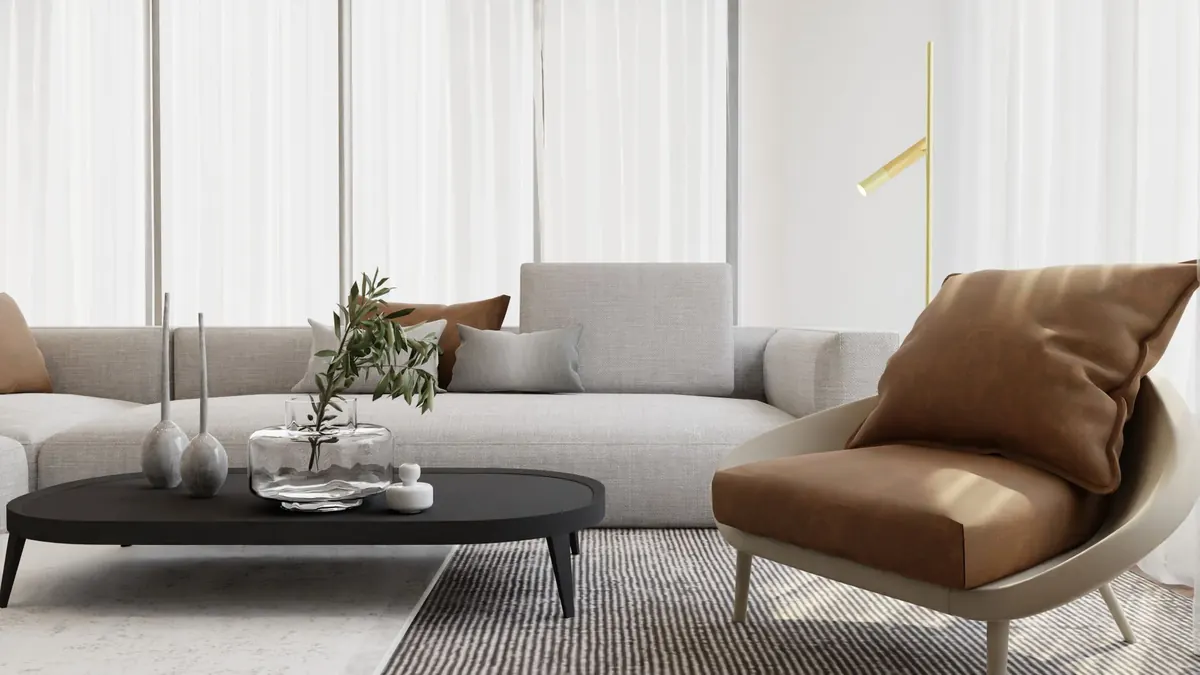
A small living room has a lighting problem that has nothing to do with taste. One ceiling light, switched on from the doorway, flattens the whole space: bright in the middle, dim in the corners, and somehow gloomier overall than it looks in daylight. Layering is the fix, and it rarely involves rewiring or spending much.
The principle is simple. Instead of asking one fitting to do everything, you give three or four lights separate jobs at different heights, then control them separately so the room can be bright for tidying up and soft for the last hour of the evening. Here is how to plan it, and what to buy in the UK without getting the bulb or the plug wrong.
Wait until it is properly dark, turn on whatever you have now, and stand in the doorway. Make a note of where the light is harsh, where your own shadow falls across the sofa, and where the corners disappear entirely.
Then sit in your usual spot and look around you — not at the ceiling. Where would a lamp need to be to light a book without shining in your eyes? Is there a socket within reach of the sofa, or would a flex trail across the floor? Measure the gap between the sofa arm and the wall, and the height of your side table. Ten minutes of this saves a lot of returns.
In a compact room you also get a fourth benefit almost for free: because the layers sit at different heights, the eye reads the room as taller and less boxy. Three or four lights also means no single one has to be bright enough to hurt.
A single pendant in the centre of the ceiling is fine if it diffuses. A fabric drum or pleated shade throws light up and sideways as well as down, which is much kinder in a small space than a bare bulb or a cluster of downlights. If you rent and cannot change the fitting, a large shade that clips or hangs around the existing flex often does the job.
Where you can, bounce ambient light off the ceiling or a pale wall rather than aiming it at the floor. An uplighter tucked behind the sofa works well in a narrow room: you see the glow on the ceiling, not the bulb itself. Keep this layer dimmable if you can, because it is the one you will want to drop right down in the evening.
Task lighting is the layer most small rooms are missing. The aim is to put light on the page, not on the person. A floor lamp beside the sofa, with the shade at roughly eye level or slightly above when you are seated, does more for comfort than any ceiling light.
A small table lamp on a side table suits a tighter corner, and an adjustable swing-arm lamp is useful if the same chair doubles as a desk. Look for a shade that is open at the bottom so the light lands where you need it, and check that the flex reaches your socket before you commit. If your own hand casts a shadow across the page, the lamp is in the wrong place — move it to the side of your writing hand.
Accent lighting is where a small room starts to feel considered. These lights are deliberately low and warm, and they are not meant to help you see much.
Two rules keep this from looking busy. First, spread the lights across at least three different heights. Second, keep accent bulbs dim and warm so they read as glow rather than glare.
British lampholders are a mix. Bayonet caps (B22 for standard, B15 for small) push and twist; Edison screws (E27 standard, E14 small) turn in. GU10 spotlights and G9 capsules appear in some fittings. Look at the existing bulb or lampholder before ordering, and never force a cap that does not want to go in. If a shade comes with its own ring fitting, it may only suit one type.
For a living room, aim for warm white around 2700K. Anything near 4000K tends to feel clinical at home, especially in a small room where you are close to the source. Ignore wattage as a measure of brightness — read the lumens. An LED labelled 8–10W is roughly equivalent to an old 60W bulb at around 800 lumens. For a compact sitting room, somewhere in the region of 1,000–1,500 lumens spread across several fittings is a sensible starting point; you can then nudge it up or down to taste.
Dimmable LED bulbs need a dimmer switch designed for them. An older switch set up for halogen may buzz, flicker or refuse to dim smoothly at low levels, and very low loads can misbehave. Trailing-edge dimmers tend to be kinder to LEDs. If the switch is old or you are unsure, ask a qualified electrician to swap it. Smart bulbs are a separate case: they dim in the app, so leave the wall switch on and avoid pairing them with a dimmer.
Count your sockets before you shop. Use fused multi-way extensions rather than stacked adaptors, do not daisy-chain leads, and uncoil an extension that is carrying a load. Smart plugs and timers are an easy way to switch several lamps on together, or to put the accent lights on a different schedule from the main one. Run cable behind furniture, along skirting or through stick-on trunking, and keep it out from under rugs and away from doorways. Any new socket or wall light is a job for a qualified electrician, and if you rent, ask your landlord first.
Once everything is in place, set three scenes and check each one. Bright: ambient plus the task lamp, for finding things. Reading: task light only, ambient off. Film: accent lights low, ambient down to a glow. If the room still works when the ceiling light is off, the layering is doing its job.
Then watch for the small irritations. Can you see a bare bulb from anywhere in the room? Move the shade or lower the lamp. Is one corner still dark? That is where the next accent light goes. Live with the arrangement for a week before buying anything else, and change one bulb at a time rather than all of them at once.
Photo: dada _design / Pexels

A practical spring checklist for UK homes: cleaner windows, lighter textiles, brighter accessories and fresh...
Learn how to combine linen, velvet, wool and cotton cushions by texture, scale and colour, and layer them...
Ten practical ways to make a small UK hallway feel wider and brighter, from oversized mirrors and layered lighting...

Feather-light inspiration for beautiful rooms..